Proteomics is at an inflection point. Not one that will be resolved by faster instruments, cheaper compute, or another exponential curve on a slide.
Those things are coming regardless.
Knowledge is getting cheaper, processing is getting faster. The pervasiveness of AI, automation, and increasingly capable platforms are compressing work that once took months into hours. That trajectory is inevitable and exciting.
What’s less certain is whether that acceleration translates into better science.
As time-to-result continues to shrink, the limiting factor shifts. It’s no longer whether we can generate or process data, but whether we can interpret it, contextualize it, and stand behind the conclusions we draw, especially when those conclusions inform decisions others will act on.
This is what we at Mass Dynamics increasingly think of as Scientific Intelligence. Not intelligence as an algorithm, but as a system: the combination of people, processes, and technology that helps scientists move from complex, multivariate data to confident, defensible decisions.
Progress at this stage of the field is less about capability, and more about judgment shaped by trust, shared language, incentives, and whether we’re willing to have the hard conversations (together) about what “good” actually looks like.
Although this evening was grounded in proteomics, the patterns that emerged - about trust, interpretation, and shared judgment - are ones I am increasingly seeing across science more broadly.
That’s why, during HUPO 2025 in Toronto, we hosted a small IGNITE dinner at Queens Harbour. No slides. No talks. No vendor theatre. Just a deliberately intimate room of people who care deeply about moving proteomics forward, and who were willing to make time for conversation in the middle of already full schedules.
And the setting was intentional.
For these conversations, we are deliberate about the environment we create. We always choose a square table. No head of the table. No hierarchy. Everyone visible. Everyone accountable to the discussion.
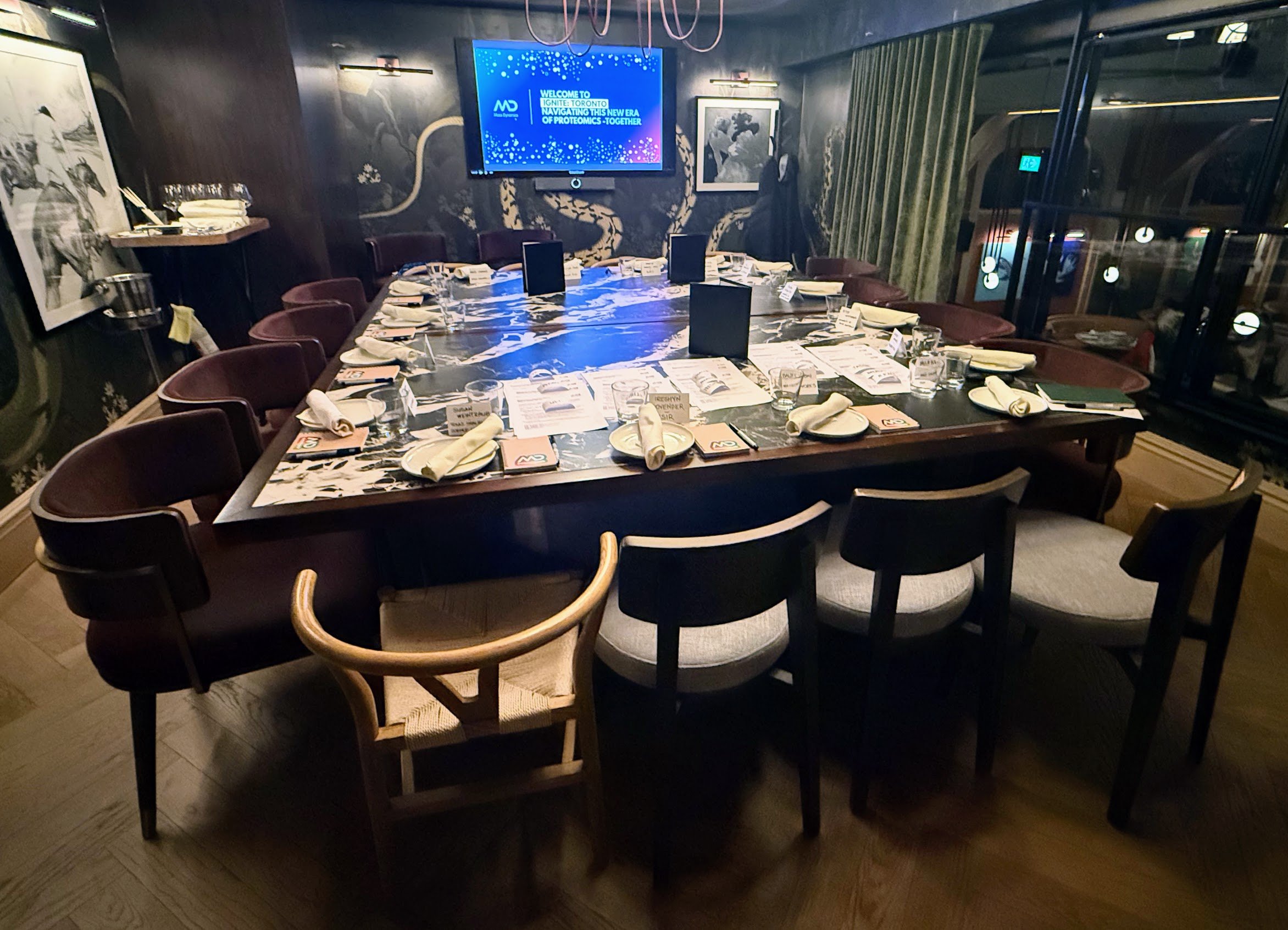
When the topic is interpretation, judgment, and trust, the physical space needs to reflect the kind of discussion and collaboration we want more of.
Who was in the room, and why that mattered
This wasn’t a room full of the same background or the same incentives, and that diversity was the point.
Around the table were scientists, facility directors, clinical leaders, and technologists - people who build methods, people who run infrastructure, people who translate proteomics into decisions others are willing to act on.
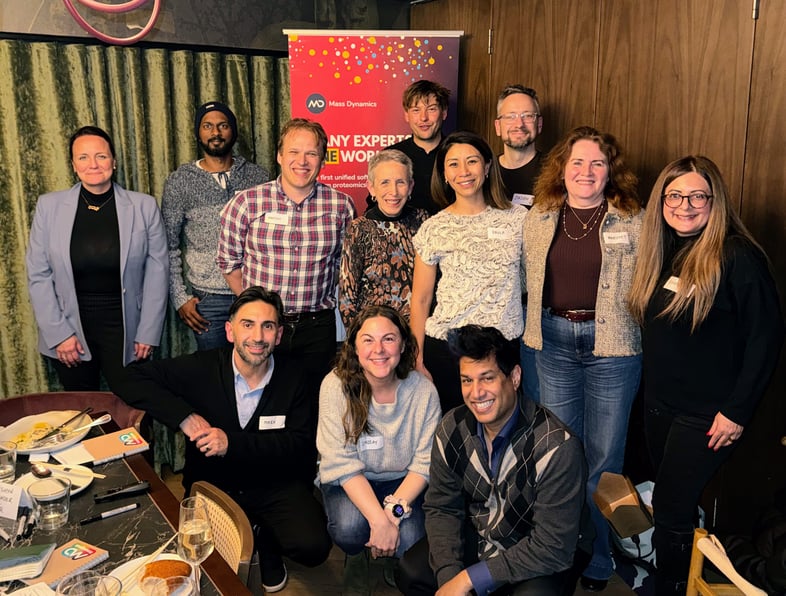
Back row (L-R): Jennifer D'Angelo (Mass Dynamics), Ireshyn Govender (Council for Scientific and Industrial Research (CSIR)), Uli Ohmayer (NEOsphere Biotechnologies), Jason Rogalski (University of British Columbia)
Middle row (L-R): Martin Daniel-Ivad (Bristol Myers Squibb), Sue Weintraub (UT Health San Antonio), Paula Burton (Mass Dynamics), Margret Thorsteinsdottir (University of Iceland), Khatereh Motamedchaboki (Thermo Fisher Scientific)
Front row (L-R): Mark Condina (Mass Dynamics), Lindsay Pino (Talus Bio), Parag Mallick (Nautilus Bio)
What struck me was generosity and vulnerability. People listened. They challenged each other without posturing. They shared stories that rarely make it into talks, papers, or grants.
More than one person said afterwards: “I wasn’t sure what this was going to be - but I’m really glad I came.”
That’s usually a sign you’re doing something right.
Why we used the “36 Questions to Fall in Love” format
I’m a software engineer by training, not someone who came up through proteomics. My lens on this field has always been shaped by people, systems, process, and culture - and by deep respect for the scientists doing the work.
One thing software teaches you early is this: you don’t fix systemic problems by shipping more features. You fix them by creating shared language, alignment, and trust.
So instead of a traditional dinner program, we borrowed inspiration from the “36 Questions to Fall in Love” - not because we expected anyone to fall in love, but because those questions are designed to accelerate trust through vulnerability.
Science doesn’t always naturally create space for that kind of trust to form. Conferences reward confidence. Papers reward polish. Grants reward certainty. Progress often starts somewhere else.
We grouped the evening into three sections - Connection, Challenge, and Change - and asked participants to mark which questions they felt drawn to. No forced answers. No right responses. Just prompts to guide conversation.
Everything operated under the Chatham House Rule, meaning guests can “share the information you receive, but you cannot reveal the identity of who said it”.
Set A: Connection - remembering why we’re here
The questions in this section included:
1. Who or what made you believe proteomics could change how we understand biology?
2. When in your career did you notice the shift from data collection to real biological meaning?
3. If you could have dinner with any scientist (past or present) who led through change, who would it be?
4. What does a perfect day in a proteomics lab look like to you?
The discussion that followed was both nostalgic and grounding.
One speaker described a single paper that reframed regulation and turnover in a way that suddenly made biology feel legible. Another reflected on the moment scale made nuance possible - not because it was faster, but because it allowed better questions to be asked. Another got inspired from their current lab head.
When people talked about a “perfect day” in the lab, no one talked about record protein counts. Instead, they talked about:
-
data they trusted,
-
experiments that were well designed,
-
and results they’d feel confident sending to a collaborator without a long list of caveats.
For me, this reinforced something important: most people didn’t come into proteomics to generate more data. They came in because proteins felt like a path to meaning.
Set B: Challenge - saying the quiet parts out loud
The questions here included:
5. What bottleneck tested your patience but taught you something about leading through complexity?6. If a crystal ball could guarantee one statement about proteomics, what would you ask?
7. If you could instantly change one behavior, habit, or system holding proteomics back, what would it be?
8. What’s the unspoken truth about proteomics - and what’s the cost of not saying it?
This is where the conversation really sharpened.
Insight 1. Experimental design is the real multiplier
One speaker said bluntly that the success or failure of most proteomics studies is decided before the first sample is run.
Across the room, heads nodded.
Misaligned expectations, missing controls, unclear endpoints. Not only do these waste time, they waste trust, samples, careers, and sometimes entire theses. Technology cannot rescue weak design, no matter how advanced it becomes.
One thing that surfaced repeatedly was how often proteomics still operates in parallel tracks. Biologists, clinicians, and proteomics technology experts are each making locally rational decisions, but not always in shared conversation.
Interpretation breaks down when assumptions stay implicit - when the biological question, the clinical context, and the analytical constraints aren’t negotiated together upfront. Progress here won’t come from better handoffs. It will come from earlier, harder conversations across disciplines, while the study is still being shaped.
Insight 2. We still reward the wrong things
Protein counts came up again and again. Not as a badge of honor, but as a problem.
One participant said, half-jokingly: “I don’t care how many proteins you measured. I care whether I can believe what you’re telling me.”
The group was remarkably aligned: output is not impact. Confidence, reproducibility, and decision-readiness matter more.
Insight 3. The bottleneck has moved (again)
Instrumentation has advanced rapidly. Standards for inference, interpretation, and shared practice have not kept pace.
Peptide-to-protein inference, proteoforms, localization, and context all came up, along with the acknowledgement that the bottleneck doesn’t disappear. It just moves. Right now, it’s not hardware. It’s coordination.
Set C: Change - what we’re willing to do differently
The final questions included:
9. “We in proteomics are on the verge of…” - finish the sentence10. What mindset will the next generation of proteomics leaders need that ours didn’t?
11. If you could standardize or automate one thing tomorrow, what would it be?
12. What’s a brave or controversial move you’re ready to make to move proteomics from “promising” to “proven”?
This section mattered most to me.
Insight 4. Translation is close - but trust is fragile
Several speakers expressed optimism about clinical relevance, paired with realism about how hard it is.
Translation doesn’t come from novelty. It comes from repeatability, clarity, and shared standards. From outputs that clinicians and biologists can act on, not just admire.
As technology accelerates with AI, automation, and cheaper computation, this becomes even more important. Faster answers are only valuable if they’re trustworthy.
Insight 5. Future leaders will be translators, not just experts
Leadership in proteomics is changing. The next generation won’t be defined by who can run the most complex instrument. They’ll be defined by who can design good studies, communicate across disciplines, and bring biologists, clinicians, statisticians, and technologists along with them.
From my perspective as a platform builder, this resonated deeply. The hardest problems are solved by people who can align systems and incentives, not just optimize one step of a workflow.
Insight 6. Standardization and automation are cultural decisions
Sample prep and QC were repeatedly identified as candidates for automation. But underneath that was a deeper truth: standardization isn’t blocked by a lack of ideas. It’s blocked by fragmentation and local optimization.
In software, automating a contested process just scales disagreement. The same applies here.
Insight 7. Collaboration only works if we reward it
One metaphor that a guest shared stuck with me, contrasting juggling and magic.
In juggling communities, everything is shared. In magic, secrecy is currency.
The guest shared their view that proteomics needs more juggling energy - more openness about what works and what doesn’t. Culture follows incentives. If we want collaboration, we need to reward it.
Insight 8. Bravery means pushing when it’s uncomfortable
The final discussion centered on practical courage.
For some, that meant pushing proteomics into clinical contexts before everything feels perfectly resolved. For others, it meant backing approaches that challenge existing workflows or business models.
One speaker said simply: patients are waiting, and waiting has a cost.
Why this matters to me
I left that dinner feeling both grounded and quietly energized.
Grounded, because it was a reminder of how complex this field really is - not just technically, but socially. Energised, because the people in that room were deeply thoughtful, generous with their experience, and genuinely committed to doing the work required to move proteomics forward responsibly.
My relationship to this field has always been shaped by how people work together around complexity - how decisions are made, how uncertainty is handled, and how systems either support good judgment or quietly undermine it.
What struck me throughout the evening was that the biggest challenges discussed weren’t about data generation or tooling. They were about interpretation, communication, and trust. About how insights are shared across disciplines. About whether outputs are robust enough that someone else (a biologist, a clinician, a regulator) would be willing to act on them.
This is where I believe the future of proteomics (and much of modern science) will be decided.
As technology continues to accelerate, the cost of misinterpretation rises. Faster answers are only valuable if they are explainable, reproducible, and defensible. Scientific progress at scale depends not just on what we can compute, but on what we can stand behind.
That’s why I care so deeply about building systems that support Scientific Intelligence - systems that respect scientific rigor, surface context, preserve provenance, and keep humans meaningfully in the loop. Not to slow science down, but to make confidence travel with speed.
Dinners like this one matter because they create space for reflection in a field that rarely pauses. They bring together people with different incentives and perspectives, and allow them to test ideas, challenge assumptions, and learn from each other, without needing to perform.
Proteomics doesn’t need louder voices or more polished narratives. It needs more alignment, better judgment, and environments where difficult questions can be explored honestly.
If this dinner was any indication, the field is ready for that next phase.
---------
This blog post was produced by Paula Burton using a combination of a recorded transcript, and notes from discussions and insights. Final compilation was completed with assistance from ChatGPT 5.2, and informally reviewed by each of the attendees. Any errors or omissions are unintentional, and the content is provided for informational purposes only. The views, thoughts, and opinions expressed in this text belong solely to the author, and not necessarily to the author's employers, organization, committees or other group or individual